I'm so pleased that I got to write about some of my favorite passions in a guest post for The Unusual Buddha! Here's a link if you'd like to read (just a few of my many) thoughts on the intersection of technology and spirituality!

I'm so pleased that I got to write about some of my favorite passions in a guest post for The Unusual Buddha! Here's a link if you'd like to read (just a few of my many) thoughts on the intersection of technology and spirituality!
Working from home has a lot of benefits. One of the challenges I hear from a lot of people is the constant access and ability to easily snack non-stop. This is a way in which mindfulness can be so basic yet so incredibly helpful. Once you have even the most basic mindfulness practice - Just enough to pause before doing something and check in to the body - you can use that to really help in a lot of ways.
You can set the intention to pause before you get up from your desk or, if - like me - you prefer to stand regularly, you can take a pause before you walk. For me I set a few mindfulness rules that cover a lot of situations.
Am I really hungry right now?
"Yes."
For what?
"Chips and dip."
How about red grapes instead?"Ooh, that sounds even better!"
I had a timely reminder this morning that the intention, for me anyhow, is not to "lose weight" but to live a longer and healthier life. As soon as we focus on losing weight we set ourselves up for failure and disappointment any time we are "not losing weight". "Losing weight" is diet culture - and this next part is absolutely critical - which implies a beginning and an end. Living a longer and healthier life is a journey instead of a destination. It's not about the finish line, it's about the crossing.
If we weigh ourselves daily and those numbers inexplicably go up a bit at a time when we feel we're working harder than ever it can hit us hard in the motivation feels. We can get discouraged and science has shown us that that one negative feeling carries a lot more power than a great many positive feelings. If that sounds specific it's because it is! I weighed in several days ago (I try to only weigh myself once per week) and I had lost 6 pounds. Fifty percent more than my estimated amount. Since then, I've worked even harder in Supernatural as I learn to love this whole new exercise option. So today when I stepped on the scale I expected (...there's that word...) some amount of loss and instead was actually up one pound!
I immediately felt that rush of disappointment, the internal dialogue "How is that possible?! I've been working hard, eating right on target, sweating twice as much!" and because of my practice I also saw the next part arise and clearly saw it had no foundation whatsoever other than that dialogue...the doubt. I would tell you what the doubt said to me, but I let it go the moment I saw it arising...it never quite got off the ground.
Instead I reflected on my previous 2010 success, and how that looked. I remembered weighing myself every day and noticing the ups and downs, and that weighing daily is often very skewed. I recalled that I focused on living a better life, not on losing weight. I focused on how I felt each day instead of how I looked or the statistics that I saw on the scale.
Today, one pound in the wrong direction apparently, I feel fantastic! I am sore in that great "I'm working out" way. I am motivated and happy. The rest will be the fruit of that!
Cliche's are cliche for a reason...it may sound cliche to say that "it's about the journey not the destination" but it's the absolute truth and may even be the key to the whole thing, so instead of worrying about the scale every day, focus on how you feel about your efforts!
Keep it up!
There's an experience one can have when meditating where, as best as I can describe it, you sort of drop into the body. This sounds a bit strange because obviously you ARE in your body, right? Well if you've experienced this you already know what I'm talking about and if you haven't yet, and you meditate with regularity, you likely will.
I think everyone tends to experience it differently, and different practitioners will likely try to tell you what they think it is and which practice it is a part of, or a step within. I'll leave that to you to determine (you're really the only one who can!). But for me I experience this shortly after the beginning of most of my meditations, when I've already settled in to my posture, spent some time with an anchor point (I use the tip of the nose), and followed my breathing for a bit. At some point I experience this "dropping in" or what I would call embodiment. There's a rush of energy through the body from top to bottom, which if it were accompanied by a sound, would sound like "WHOOOMP!". And the peaceful feeling "There it is."
Suddenly I find myself truly in my body. Not a bunch of slightly uncomfortable individual parts and experiences but one big whole experience together with no discernible boundaries, and then I notice a small round bright spot in the center of my closed-eye field of vision. Before this moment, that would be a sort of liquid movement of dark shades of blue and black like when your eyes are just closed but you still see amorphous shapes of different shades of dark. That spot stays in the center and steady and is bright instead of dark. Again, this is my experience and yours may differ. But I would suggest that the "embodiment" feeling, regardless of the specifics, is roughly similar.
I experience it as a sense of joyful homecoming.
Now...the reason for today's post is that I've now been back on the Mindful Eating and Mindful Living path that brought me to Buddhism for about 17 days (the exercise portion has been sporadic until recently) and today feels like that moment in meditation I described above, but with regard to the EvolVR implementation of my M.E.A.L.S. program. What I mean by that is that I've been getting more and more excited about it with each day I've been back at it. Today, at day 17, I suddenly no longer feel like this is a thing that might happen...I feel like I've dropped in ("WHOOOMP!") and it's here and happening now and there's no boundaries between the ideas and parts and people involved, but rather one big unified community in it together. "There it is."
I don't have a clue if anyone else in the community we're building feels it or will just think this is super weird, but this is where I am with it today and it feels great. I wanted to shout it from the rooftops, but I figured I'd chronicle it here.
As always, if anyone has questions or comments hit me up.
Really when we meditate, what is it we are doing? Much of what we are doing is training the mind. Perhaps all of what we are doing. It is said that there are 84,000 Dharma Doors or ways into the dharma, and one way is the Tibetan Practice of Lojong.
I was only introduced to it myself just this month so it’s new for me in formal introduction. But once I started studying it, it felt like an old friend. My very first thought was that it was a Tibetan version of a koan, which isn’t exactly true, but that’s the most obvious connection you might make when you start learning about it. So many of the slogans were already very familiar territory for me. I’ll come back to slogans in a moment.
So, this is just one more way to practice the dharma, and it’s a way that is supposed to be particularly effective at training the mind, hence the name “Mind Training!” It utilizes aphorisms, known as slogans, which as I said makes me think of Koans.
A teacher named Atisa is credited with its creation but he developed it after studying with a sumatran teacher for 12 years and then cultivated it beyond. I think I read that it was developed fully over the course of 300 years. Think about that for a second…a training for the mind that was established and then honed for three centuries before being considered ready for prime time! That, to me, puts some serious weight behind it.
These 59 slogans are kind of grouped into 7 areas. And of course there’s been many commentaries done on them over the years. The ones I’m using for my practice this month are the book “Training in Compassion: Zen teachings on the Practice of Lojong by Norman Fischer” and the Tricycle articles by Judy Lief, as well as the practical daily usage of Pema Chodron’s Compassion Cards, the latter of which solidified my love of this practice.
The seven points or groupings are:
The preliminaries which are the basis for dhamma practice
Slogan 1
The main practice of training in Bodhicitta
Slogan 2-6
Slogan 7-10
Transformation of bad circumstances in to the way of enlightenment
Slogan 11-16
Showing the utilization of practice in one’s whole life
Slogan 17-18
Evaluation of Mind Training
Slogan 19-22
Discipline of Mind Training
Slogan 23-38
Guidelines of Mind Training
Slogan 39-59
My assignment this month in my Dharmacharya program is to choose one to write about. It was a tough call because there were many that I enjoyed, and several I found challenging for different reasons. Some are difficult because the practice isn’t one I normally do (Tonglen). Some are challenging because they’re very, very in depth. But the slogan that jumped out for me first was the last, and after reading them all and working with about half of them this month (I’m taking them one per day so it will be another month before I work through them all) I’ve chosen to write a bit about:
59. DON’T EXPECT APPLAUSE (Don’t expect to receive credit for your good deeds, just do them anyway!)
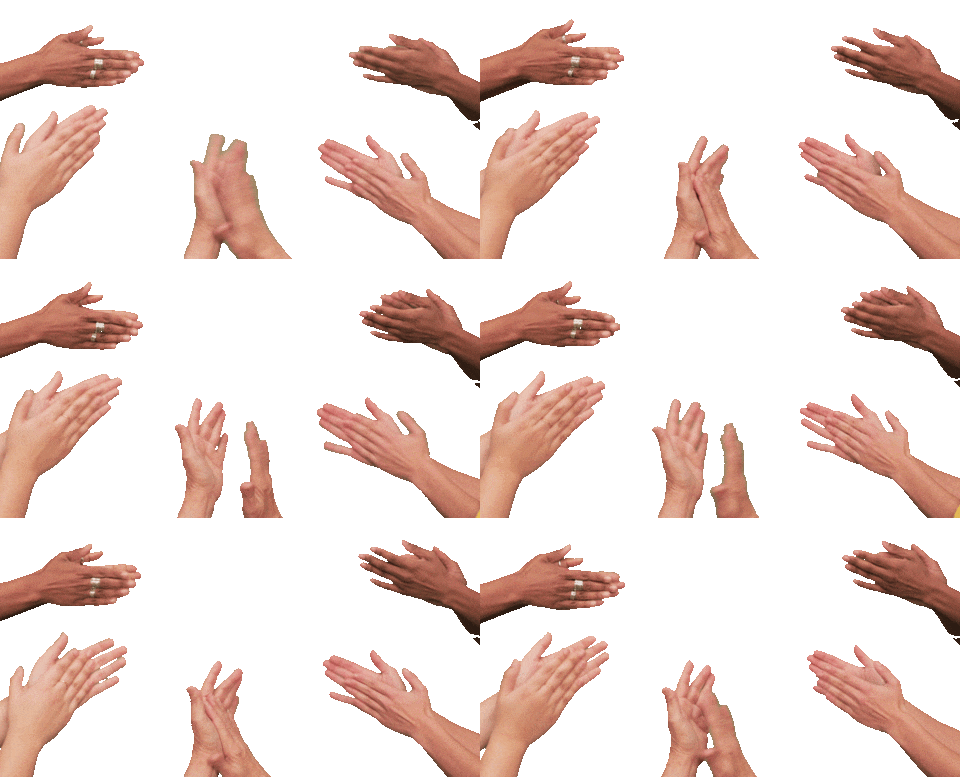
I knew when I read this one that I’ve made a lot of progress in my lifetime on this, and most of that during my buddhist practice. But I also knew that I have a “long way to go and a short time to get there”, in the immortal words of the great sage Jerry Reed. I’ve come a long way with this slogan’s practice and I largely feel I’ve got it fairly well in hand, but I also know I have to pay close attention to it and always question not only what I’m doing but also (and most especially) why.
It’s an ongoing practice – a mindfulness practice, really – that I must be prepared to stay with always, lest I slip into old habits of the ego. It’s a challenge I’m prepared to face for the long term, which is why I consider it the most difficult. To further quote The Snowman’s song “East Bound and Down”... I’m “gonna do what they say can’t be done!”
Those old habits of the ego are not so far in my rear view mirror that I don’t still feel the suffering they can cause, and these days I’m watching the road ahead much more attentively than I did in the past. In my younger days, and even now when I’m not mindful, I can often fall into the trap of doing good for the sake of being seen doing good. A low form of generosity, to be sure. The highest form of giving then, is said to be that of the bodhisattva giving with an utter disregard for the benefit to oneself, only out of compassion.
The other aspect of this slogan is that it’s not limited to just good deeds and generosity, but anything at all that one does and then seeks praise or applause for. It could be an accomplishment in one’s own life such as a promotion at work, or washing the dishes at home. And take it from me, spouses don’t generally find it all that impressive when we do the same chores they do and wish to be congratulated for it!
Even as I write this blog post, a portion of which will serve as my homework for the month, the irony of that is not lost on me. Blogging is in some way a fame seeking endeavor. Assuming you have followers or want them. Luckily I blog solely out of the hope that it will be of some use to someone who might see it. It’s essentially a journal that I hope others may find useful. But, I must be mindful of what’s going on “behind the scenes” as I write and what my intentions are. So it’s the intention of the blogging, not the blogging itself, that I look for.
Do I just want to be seen as being knowledgeable about Lojong or Buddhism? Am I trying to come off as a great and wise teacher or gain notoriety as one? Am I sharing the dharma out of compassion for other beings in the hopes that they will find something useful in these words? Is it a mixture of all of these things? If I’m sharing for fame and glory…why?
Anyone who knows me would likely say that I am enthusiastic, to say the least. And that’s the main effort for me. I have to pay close attention to the difference between enthusiasm and bragging. I guess really it just comes down to the fact that when you do anything, be it acts of generosity or awesome feats, if you do it with the expectation of being lauded for it, you’re more firmly establishing a false sense of “I, Me, Mine” and thus missing the mark of the dharma entirely, not to mention devaluing the good deed you may have done.
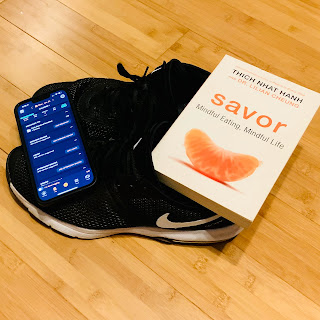

Photo by Braxton Stuntz on Unsplash "Try to be mindful. And let things take their natural course. Then your mind will become still ...


